Signs you need this
- • Walls left rough and patchy after wallpaper removal — torn paper, adhesive residue, raw gypsum showing
- • Paint that looks chalky or uneven in sheen across one wall
- • Walls repaired so many times that patch outlines and texture variation show under raking light
- • Plaster cracking, crumbling at corners, or separating from the lath behind it
- • Flat or high-sheen paint making every seam and trowel mark visible in a renovated room
- • An architect or designer has specified a Level 5 finish on the drawings
What the service involves
Skim coating applies one or more thin layers of joint compound across an entire wall or ceiling — not just patches — sanded to a Level 5 finish, the highest standard in the GA-216 specification. It’s the correct repair after wallpaper removal, after accumulated repairs have left a surface too varied to paint out evenly, or when an architect specifies Level 5 for walls or ceilings receiving flat or high-sheen paint.
What Level 5 actually means
GA-216 defines finish levels 0 through 5. Level 4 — the standard for most painted walls — covers all joints, fasteners, and angles. It’s sufficient for most interior paint applications. Level 5 adds a full skim coat of joint compound over the entire surface on top of the Level 4 finish, sanded flat. The difference matters when paint sheen is high, when windows or architectural lighting throw raking light across the surface, or when a listing shoot’s camera angle will reveal any surface variation. At Level 4, tool marks, fastener heads, and seam lines are there — they just aren’t visible under typical ambient lighting. Under flat paint and raking light, they are.
PVA primer: why it can’t be skipped
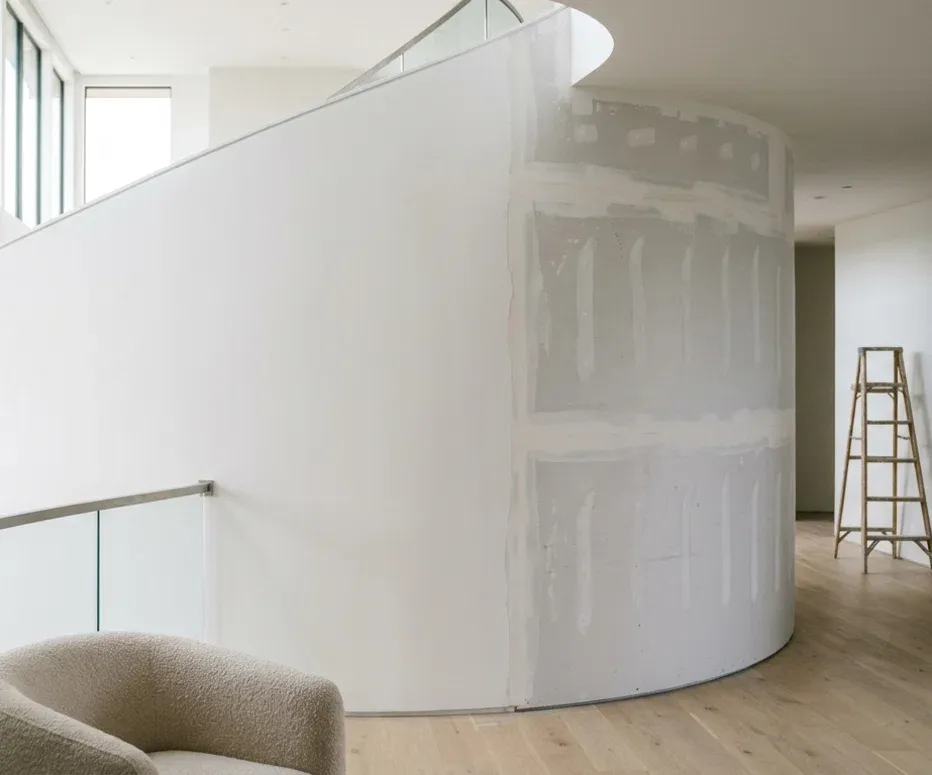
Before any compound touches the wall, we apply PVA drywall primer. This is the step most skim coat jobs skip and then regret. PVA seals the surface — particularly the highly absorbent areas where raw gypsum core is exposed after wallpaper removal — so that joint compound dries at a consistent rate across the entire surface. When compound is applied to an unsealed substrate, it dries faster where the surface is more absorbent and slower where it’s less porous. The result is flashing: a mottled, uneven appearance visible through the finished paint regardless of how many coats go on. PVA eliminates the variation before the compound goes down.
The coating process
On wallpaper-removal damage, we often start with a base coat of setting compound over torn paper areas before the skim coats go on. Setting compound sets chemically and doesn’t shrink, giving a dimensionally stable surface for the finish coats. For clean new drywall, two skim coats of topping compound — applied perpendicular to each other, sanded between coats — typically reach Level 5. We check the surface under a raking work light between coats; if it’s not right, we skim and sand again before calling it done. A second PVA prime coat seals the fresh compound before handoff.
Plaster substrates
In Glenbrook and Springdale homes from the 1950s and 1960s, original plaster over lath is common. Plaster that’s still bonded can be skim coated directly — we assess bond strength first and apply a consolidant where needed before compound goes on. Plaster that’s separating from the lath, bowing, or crumbling is a different scope: the failing material comes down, new board goes up, and then the surface is taped, finished, and skim coated to Level 5. Skimming over failing plaster doesn’t hold — the movement in the substrate cracks the skim coat.
When spot patching is the better call
Skim coating the full wall makes sense after wallpaper removal from an entire wall, when accumulated repairs have made the surface too varied to paint out, or when Level 5 is specified. Spot patching is the right call when damage is localized and the surrounding surface is in good condition. If you’re on the fence, we assess on-site and tell you which approach makes more sense before quoting either one.
Materials & standards
Products & materials we use
- USG Sheetrock Topping Compound (finish skim coats)
- USG Sheetrock All-Purpose Compound (skim and taping)
- Durabond / Easy Sand (setting compound, base coat)
- PVA drywall primer / Gardz (seals torn paper and raw gypsum)
Standards & codes we work to
- GA-216 finish levels (Level 4 / 5)
- CT DCP HIC registration
What the terms mean
- Skim coat
- Flashing
- Paper-face delamination
- Setting vs. topping compound
- Plaster over lath
- Raking light
- PVA prime
Options & variants
| Option | When it applies | Cost |
|---|---|---|
| Single wall skim | One wall with localized wallpaper or repair damage; the rest of the room is fine | Lower |
| Full room skim | Whole-room wallpaper removal, or multiple walls too varied for spot repair | Mid |
| Ceiling skim (Level 5) | Ceilings taking flat paint, or rooms with new recessed lighting or large windows | Higher per sq ft |
| Plaster stabilization + skim | Plaster still bonded to lath but with surface cracks or crazing | Mid |
| Full plaster-to-drywall conversion + skim | Plaster separated from lath, failing, or moisture-damaged | Highest |
| New construction Level 5 | New drywall finished to Level 4, then skimmed to Level 5 per spec | Premium |
What affects cost
- • Square footage — the dominant variable; walls and ceilings priced separately.
- • Number of coats required — clean drywall reaches Level 5 in two coats; wallpaper damage often needs a base coat plus three.
- • Ceiling vs. walls — overhead work prices higher per square foot.
- • PVA prime requirement — two PVA coats (before and after skimming) are standard scope.
- • Existing surface condition — old repairs, competing textures, or plaster variation add prep.
- • Level 5 vs. Level 4 — Level 5 requires a full skim layer over the entire surface.
- • Plaster substrate — bond assessment, consolidant, or full conversion changes the scope.
- • Access and room conditions — furniture protection, built-ins, or complex geometry add time.
Price ranges
Low end
$600–$1,800
Single wall or small room under 300 sq ft, minimal damage, clean substrate, two coats, PVA both passes.
Typical
$1,200–$4,500
Full room, wallpaper damage needing a base coat, two to three coats, standard ceiling, both PVA primes.
High end
$3,000–$10,000+
Multiple rooms, Level 5 on walls and ceilings, plaster stabilization or conversion, or architect-specified new-construction finish.
What to expect
- 1
Assessment
We inspect substrate type, paper-face condition or plaster bond, moisture, and surface variation — which sets the number of coats and base-coat approach.
- 2
PVA prime — first coat
PVA primer seals the surface before any compound, preventing flashing — the mottled look from compound drying at different rates over different porosity.
- 3
Base coat (if needed)
Setting compound fills low spots and stabilizes torn paper or plaster variation; it sets chemically and doesn't shrink.
- 4
First skim coat
A thin layer of topping compound over the entire surface with a 12-inch or wider knife, applied at consistent pressure without ridges.
- 5
Light sand
High spots and tool ridges knocked down once dry — a cleanup step, not a finish sand.
- 6
Second skim coat
Applied perpendicular to the first to catch direction-specific variation; this is the critical coat for Level 5.
- 7
Final sand
Pole-sanded to eliminate all tool marks, checked under a low-angle raking light. If anything shows, we skim and sand again.
- 8
PVA prime — second coat
The fresh skim coat is sealed again before handoff so paint absorbs evenly and the skim doesn't read through the sheen.
- 9
Handoff
Paint-ready at Level 5; we confirm the surface with the painter under their lighting before the first coat goes on.
When this isn’t the right call
- If damage is localized to a small area → drywall repair and a texture match is likely cheaper and sufficient.
- If plaster is sound and only cosmetically cracked → spot compound and a targeted skim may be enough.
- If walls will receive heavy wallcovering, tile, or wainscoting → skim coat isn't the right prep for those finishes.
- If the damage is from active moisture → resolve the source and dry the substrate first. See water damage drywall repair.
- If plaster is separating from lath across large areas → that's a full plaster-to-drywall conversion, not a skim coat.
Frequently asked questions
My wallpaper is off but the walls look destroyed — torn paper everywhere. Can a skim coat fix that? +
Yes — it's the most common reason we skim coat in Stamford and Greenwich. We apply a setting-compound base coat over the torn areas to stabilize them, then skim the full wall to a paintable surface with no sign of the damage. Painting over stripped wallpaper paper without skimming shows every flaw through the finish, especially under natural light.
What's the difference between Level 4 and Level 5? My painter mentioned I might need Level 5. +
Level 4 — seams, angles, and fasteners covered and sanded — is standard for most painted walls. Level 5 adds a full skim layer over the entire surface, eliminating remaining texture and trowel marks. It's required for flat or matte paint, high-sheen paint, or surfaces under strong raking light. Architects in Greenwich, Darien, and North Stamford routinely spec it as the baseline.
Why does the surface need to be primed before you skim coat it? +
PVA prime seals the substrate so compound dries at a uniform rate. Without it, compound over raw paper or torn areas dries faster than over intact paper, leaving a mottled surface — flashing — that persists under paint. Skipping it is the most common reason DIY skim coats look bad.
My walls are original 1950s plaster. Can you skim coat plaster, or does it have to come out? +
It depends on the bond. If the plaster is firmly attached — solid when tapped, no movement, just surface cracks — it can often be stabilized and skim coated directly. If it's soft, hollow-sounding, separating, or moisture-damaged, removal and new drywall is the right call. We assess on-site and give you an honest answer; we've done both in Glenbrook and Springdale homes.
How long does skim coating a room take? +
Typically two to three days, accounting for dry time: day one PVA prime and first skim coat, day two second coat, day three final sand and second PVA prime. Wallpaper damage needing a base coat adds a day. We won't rush dry time — compound sanded wet looks fine in shop light but shows under raking light after paint.
Will the skim coat be visible under the paint? +
Not if it's done right and properly primed. The keys are a flat surface at Level 5 — nothing visible under a low-angle light — and two PVA prime coats, one before skimming and one after sanding. The second prime is what keeps the skim from reading through the paint. We always prime before handoff and confirm with the painter first.
Can you match the existing texture in rooms we're not skim coating? +
Skim coating brings a surface to smooth Level 5 — there's no texture on the skimmed surface to match. The question is whether adjacent textured rooms look inconsistent; usually the break falls at a corner or doorway, so the transition is clean. If you want a heavy knockdown or orange peel preserved, we keep the skim within the room boundaries and flag any transition issue before starting.
Do you do the painting, or just the skim coat? +
Skim coat and prime only — we hand off paint-ready. We can refer painters we've worked alongside on Gold Coast renovations and coordinate timing so they're lined up before our work is done.