
Signs you need this
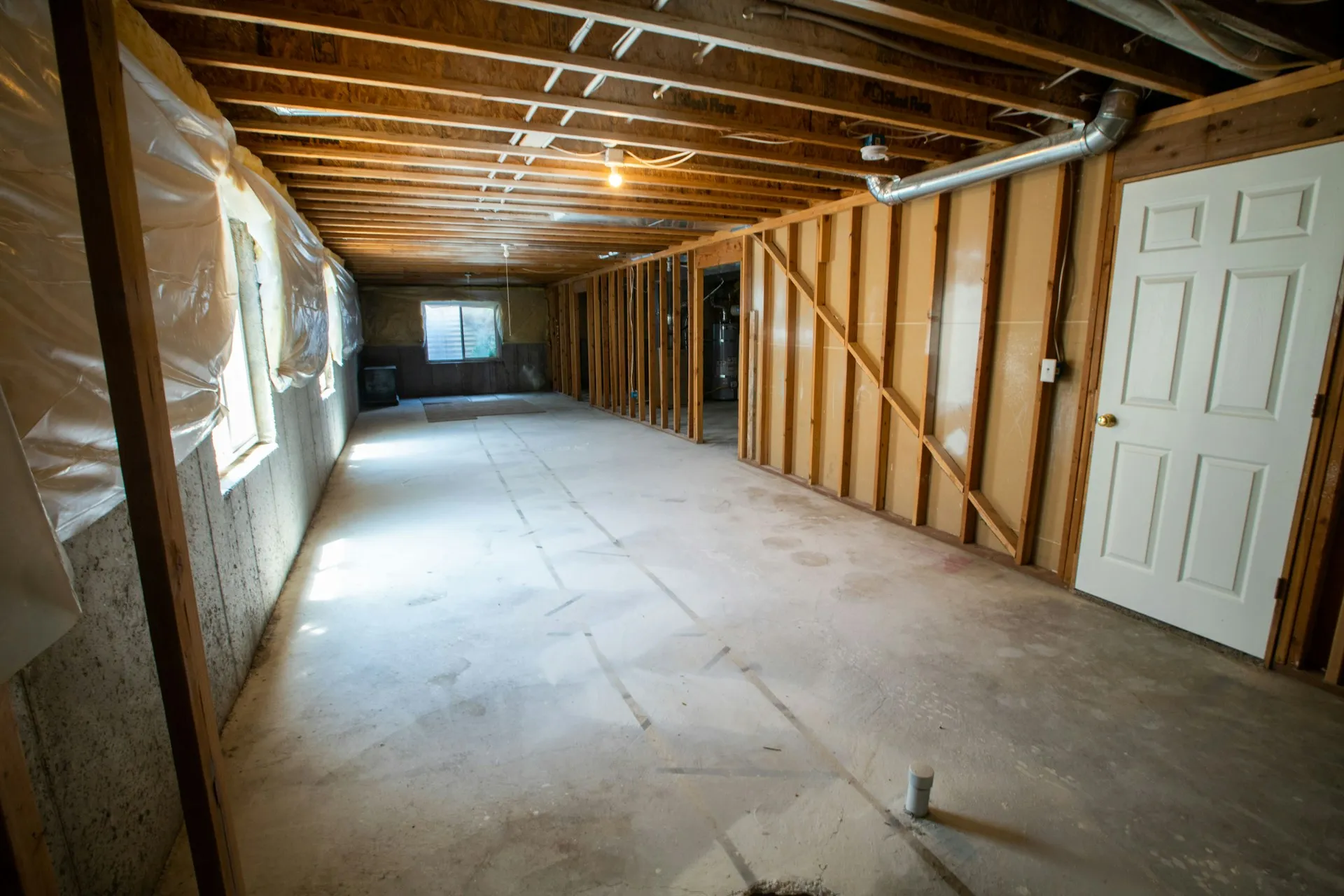
- • An unfinished basement with exposed studs or bare concrete that's wasted square footage in a North Stamford or mid-country estate colonial
- • A partially finished basement from a prior owner with sagging, water-stained, or outdated wall panels that need to come out and be redone correctly
- • A need for a home office, gym, or media room but no legal egress or proper framing in the space
- • Musty odor or visible dampness along foundation walls that makes a homeowner wary of finishing without addressing moisture first
Framing a basement for Stamford’s ground conditions, not just the floor plan
Stamford’s older housing stock, particularly the large pre-war and mid-century estate colonials scattered through North Stamford and mid-country, tends to sit on foundations that were built for storage and mechanicals, not living space. That means basement finishing here starts with a question a lot of homeowners don’t expect: how is this wall going to handle contact with a fifty- or eighty-year-old foundation wall. Framing set directly against damp masonry traps moisture behind the new board, which is how a basement finish that looked great at move-in develops a mold problem within a couple of humid Connecticut summers. Stamford Elite Drywall frames with a gap off the foundation wall and selects insulation and board that can tolerate occasional moisture transfer rather than assuming the concrete is bone dry year-round.
Homes closer to the water, in The Cove and parts of Shippan Point, carry an added layer of this problem: a higher water table and occasional storm surge risk mean some basements see dampness after a hard Nor’easter even when they’re dry the rest of the year. For those basements, moisture-resistant or mold-resistant board isn’t an upsell, it’s the difference between a finish that survives the next big storm and one that has to be cut out and replaced. Stamford Elite Drywall reads the basement’s actual moisture history, not just its current condition, before recommending a board system.
Egress, ceiling height, and the mechanicals nobody wants to look at
A basement that’s going to function as a bedroom, not just a rec room, has to clear egress requirements under the state building code, which generally means a window or door sized and positioned so someone can get out in an emergency without needing a ladder or tool. That’s a decision made early, because framing and window rough openings have to accommodate it before board ever goes up, not after. Even basements that aren’t intended as bedrooms benefit from thinking about egress and natural light early, since retrofitting an egress window into a finished wall later means tearing that wall back out.
Ductwork, plumbing stacks, and structural beams are the other reality of finishing a basement in an older Stamford home, where mechanicals were often run wherever was convenient rather than planned around a future finished ceiling. Framing soffits and bulkheads around these elements, rather than dropping the entire ceiling to clear the lowest pipe, keeps headroom as generous as the space allows. Getting this wrong is one of the most common complaints homeowners have about a basement finish, either a ceiling that feels oppressively low or an ugly box running down the middle of an otherwise clean room. Stamford Elite Drywall maps the mechanicals before framing begins so the finished ceiling reads as an intentional design choice, not an afterthought built around whatever was already there.
Materials & standards
Products & materials we use
- USG Mold Tough
- Gold Bond XP
- Georgia-Pacific DensArmor
- National Gypsum Gold Bond
Standards & codes we work to
- 2022 Connecticut State Building Code (2021 IBC/IRC)
- IRC R302
- ASTM C1396/C840
What the terms mean
- metal-stud framing
- moisture-resistant board
- egress
- bulkhead
- soffit
- joint compound
- corner bead
Options & variants
| Option | When it applies | Cost |
|---|---|---|
| Standard framing and finish | Dry basement, no history of water intrusion | Lower cost |
| Moisture-resistant board system | Basement with occasional dampness or proximity to the water table | Moderate cost increase for board upgrade |
| Egress-compliant bedroom conversion | Basement space intended as a legal bedroom | Higher cost, includes egress window coordination |
| Full remodel with framed bulkheads and soffits | Basement with exposed ductwork, plumbing, or low-clearance beams | Higher cost, more framing labor |
What affects cost
- • Whether the basement needs new framing from scratch or is finishing over an existing frame
- • Board selection: standard versus moisture-resistant or mold-resistant board where dampness history warrants it
- • Ceiling height and the need to build around ductwork, plumbing lines, and structural beams with soffits and bulkheads
- • Whether an egress window needs to be added or verified to code for a bedroom conversion
- • Insulation requirements against the foundation wall before framing goes up
What to expect
- 1
Walkthrough
We check the unfinished or previously finished basement for moisture signs, ceiling height, and existing mechanicals.
- 2
Egress discussion
If any room is intended as a legal bedroom, egress requirements are discussed and coordinated with your general contractor if one is involved.
- 3
Framing
Walls and any soffits needed around ductwork or beams are framed, set to allow proper spacing off foundation walls.
- 4
Board and finish
The appropriate board system, moisture-resistant where warranted, is hung and finished to a smooth, paint-ready level.
- 5
Final walkthrough
We review outlet and switch locations, corner and edge finish, and readiness for flooring and trim.
When this isn’t the right call
- If the basement has active water intrusion or standing water during storms, that needs to be resolved by a waterproofing contractor before any framing or board goes up here.
- If the concern is primarily a musty smell with no framing project planned, a targeted moisture-resistant drywall board upgrade is a better fit than a full finish.
- If the project is removing a failed prior basement finish rather than adding a new one, drywall removal and demolition should happen first.
Frequently asked questions
Do I need special drywall for a basement, or is standard board fine? +
It depends on the basement's moisture history. A consistently dry basement with no prior water issues can use standard board above a vapor-appropriate framing setup. A basement with any history of dampness, especially in homes near The Cove or Shippan Point where the water table runs higher, does better with moisture-resistant or mold-resistant board.
Can I turn my basement into a legal bedroom? +
Only if it meets egress requirements under IRC R302, which generally means an egress window or door of a minimum size and sill height that a person can use to exit in an emergency. Stamford Elite Drywall frames around egress requirements but doesn't cut the window opening itself, so this gets coordinated with the general contractor or window installer.
How do you handle ductwork and plumbing that run through the basement ceiling? +
Low-clearance ductwork, plumbing, and beams get framed into soffits and bulkheads rather than boxed in haphazardly, keeping ceiling height as high as possible while still concealing the mechanicals cleanly.
Will finishing my basement trap moisture problems I can't see? +
That's exactly why the walkthrough checks for moisture signs before framing starts. Finishing over an undiagnosed dampness issue with the wrong materials is how basements end up needing to be redone; the right board choice and framing setup avoids that.
How long does a basement finishing project take? +
A single-room basement finish typically runs one to two weeks from framing through final finish, depending on the extent of framing needed around mechanicals and whether moisture-resistant systems add drying time between coats.