
Signs you need this
- • A repaired patch that's structurally fine but visibly smoother or rougher than the wall around it once the light hits at an angle
- • Two rooms in the same house, an original section and a later addition, with noticeably different wall textures
- • A homeowner in Springdale, Glenbrook, or Belltown wanting to update a dated heavy knockdown or stomp texture to a more modern, subtle finish
- • A previous repair job left a flat or smooth patch on an otherwise textured wall, and it's obvious every time the sun comes through the window
- • Buying a house with mismatched textures between an original section and a prior owner's addition, and wanting it unified before moving in
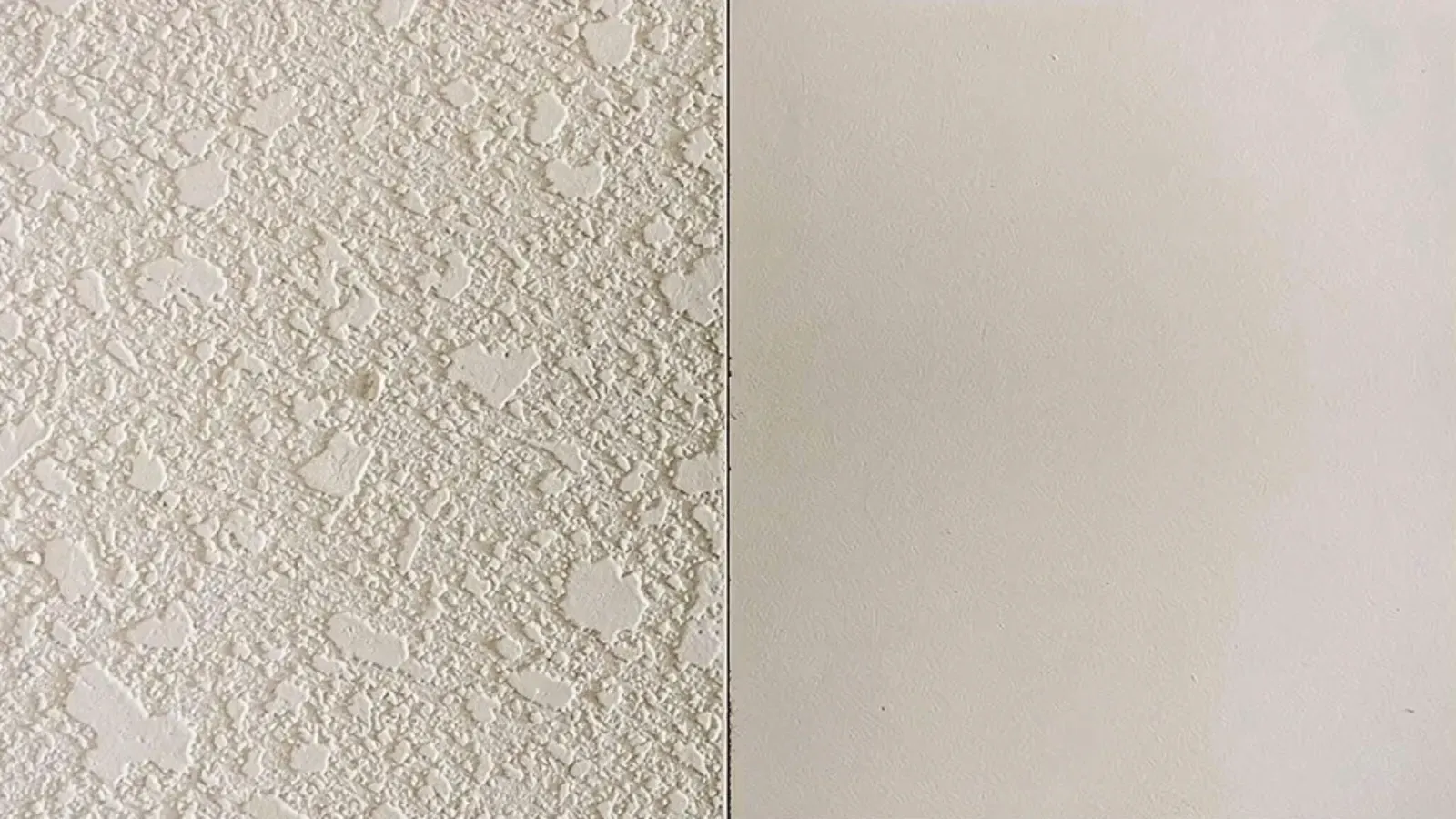
Stamford Elite Drywall matches or updates wall and ceiling texture, most commonly knockdown and orange peel, so a repair or addition reads as part of the original surface instead of a visible patch. Matching starts with identifying the existing pattern’s spray or trowel technique and compound consistency, then testing on a scrap or inconspicuous area before touching the visible wall. Where a homeowner wants to move away from an older heavy texture toward something more contemporary, the existing texture is skimmed down or removed first so the new pattern applies cleanly rather than telegraphing through the old one.
Why a technically good patch can still look wrong
A repair can be structurally perfect, properly backed, taped, and coated, and still be obvious from across the room, because texture is the part most repair crews treat as an afterthought. Knockdown and orange peel are both sprayed or troweled patterns applied at a specific compound consistency and a specific technique, and no two crews, or even the same crew five years apart, reproduce them identically without deliberately trying to match what’s already there. That’s the gap Stamford Elite Drywall closes: before touching the visible wall, the existing texture gets identified for pattern size, spray density, and knockdown timing, and the match gets tested on a scrap board or a hidden section of the same wall, inside a closet, behind where furniture sits, so the first real attempt on the visible surface isn’t a guess. Skipping that test step is the single most common reason a homeowner ends up with a repair that’s smooth where it should be textured, or textured too heavily compared to the surrounding field.
Springdale, Glenbrook, and Belltown make this especially relevant, since a lot of the housing stock there has been added onto and repaired in layers over decades, an original section from one era, a rec-room addition from another, a repair from a previous owner’s contractor patched in without much thought given to the surrounding wall. Walk through enough of these houses and it’s common to find three different texture patterns across three rooms that should read as one continuous house. Unifying that isn’t just a repair, it’s a judgment call about which existing pattern to standardize toward and how to blend the transition zones between rooms so the change isn’t itself another visible seam.
Updating a dated texture without it looking like a patch job
The other common call isn’t matching, it’s replacing: a homeowner wants to move away from a heavy 1980s or 1990s knockdown or stomp texture toward something lighter and more contemporary, often a fine orange peel or a smooth Level 4 or 5 finish. This is a different technical problem than matching, because the old texture has to be dealt with first, either skimmed down flat enough that a new lighter texture applies cleanly over it, or removed back to bare board where the old pattern would otherwise telegraph through a thin new coat. Doing this room by room, rather than gutting an entire house at once, creates its own matching challenge: the newly updated room now needs to read intentionally different from the untouched rooms, not like an abandoned mid-project change. Stamford Elite Drywall plans texture updates with that sequencing in mind, so a homeowner modernizing one room at a time ends up with a house that reads as a deliberate before-and-after, not a patchwork of half-finished changes.
Materials & standards
Products & materials we use
- USG Sheetrock
- Joint compound (setting and pre-mixed)
Standards & codes we work to
- GA-214 finish levels (0-5)
- CT Home Improvement Contractor (HIC) registration
What the terms mean
- Knockdown texture
- Orange peel
- Texture matching
- Skim coat
- Joint compound
Options & variants
| Option | When it applies | Cost |
|---|---|---|
| Knockdown texture match | Blending a patch or addition into an existing knockdown wall | Baseline for texture work |
| Orange peel texture match | Blending into a finer, spray-applied orange peel finish | Similar to knockdown |
| Texture removal and re-texture | Updating a dated heavy or stomp texture to a modern finish | Higher, more prep work |
| Texture-to-smooth conversion | Removing texture entirely to prep for a Level 5 finish | Highest, most labor-intensive |
What affects cost
- • Area needing texture work — a single patch versus a full room or floor
- • How closely the existing texture pattern needs to be identified and reproduced
- • Whether old texture needs to be removed first or the new work can be blended directly over it
- • Ceiling versus wall texture — ceilings generally take longer per square foot
- • Number of coats of primer or sealer needed before texture is reapplied
What to expect
- 1
Identify the pattern
Inspect the existing texture and identify the technique and compound consistency used.
- 2
Test the match
Test the matching technique on a scrap board or inconspicuous section first.
- 3
Prep
Prep the repaired or new area so it accepts texture the same way the surrounding wall does.
- 4
Apply and blend
Apply and blend the texture into the existing field, feathering the edge so no line is visible.
- 5
Final check
Let it cure and do a final check under natural light before considering it complete.
When this isn’t the right call
- If the underlying issue is a hole or crack that hasn't been patched yet, drywall repair and patching is the better fit.
- If the goal is eliminating texture entirely for a smooth, glare-free wall, a skim coat to Level 5 finish is the better fit.
Frequently asked questions
Can you match my existing wall texture so a repair doesn't stand out? +
Yes, matching an existing knockdown or orange peel pattern so a patch blends into the surrounding wall is one of the most common reasons homeowners call.
My house has different textures in different rooms, can you make them consistent? +
Yes, this comes up often in Springdale and Glenbrook homes with additions built at different times, and unifying texture across rooms is a standard part of this service.
Do you test the texture match before doing the full wall? +
Yes, the technique is tested on a scrap board or an inconspicuous section of the actual wall first, since texture patterns vary enough between houses and even between rooms that a blind match risks standing out.
Can you update an old heavy texture to something more modern? +
Yes, older heavy knockdown or stomp textures can be skimmed down or removed and re-textured with a lighter, more contemporary pattern.
How do you match texture on a ceiling versus a wall? +
Ceiling texture generally takes more time to match since lighting hits it differently than a wall, and access is more involved, but the identification and test-patch approach is the same.
What if I want the texture removed completely instead of matched? +
That's a texture-to-smooth conversion, which removes the existing texture and preps the surface for a Level 5 skim finish instead of matching the old pattern.