
Who this is for
- General managers and property engineers at downtown Stamford hotels
- Ownership groups and brand-managed renovation teams doing phased guest-room turns
- General contractors on hotel renovation or PIP (property improvement plan) projects
- Event and banquet-space managers near Stamford Town Center needing finish-level ballroom work
Renovating a hotel that never actually closes
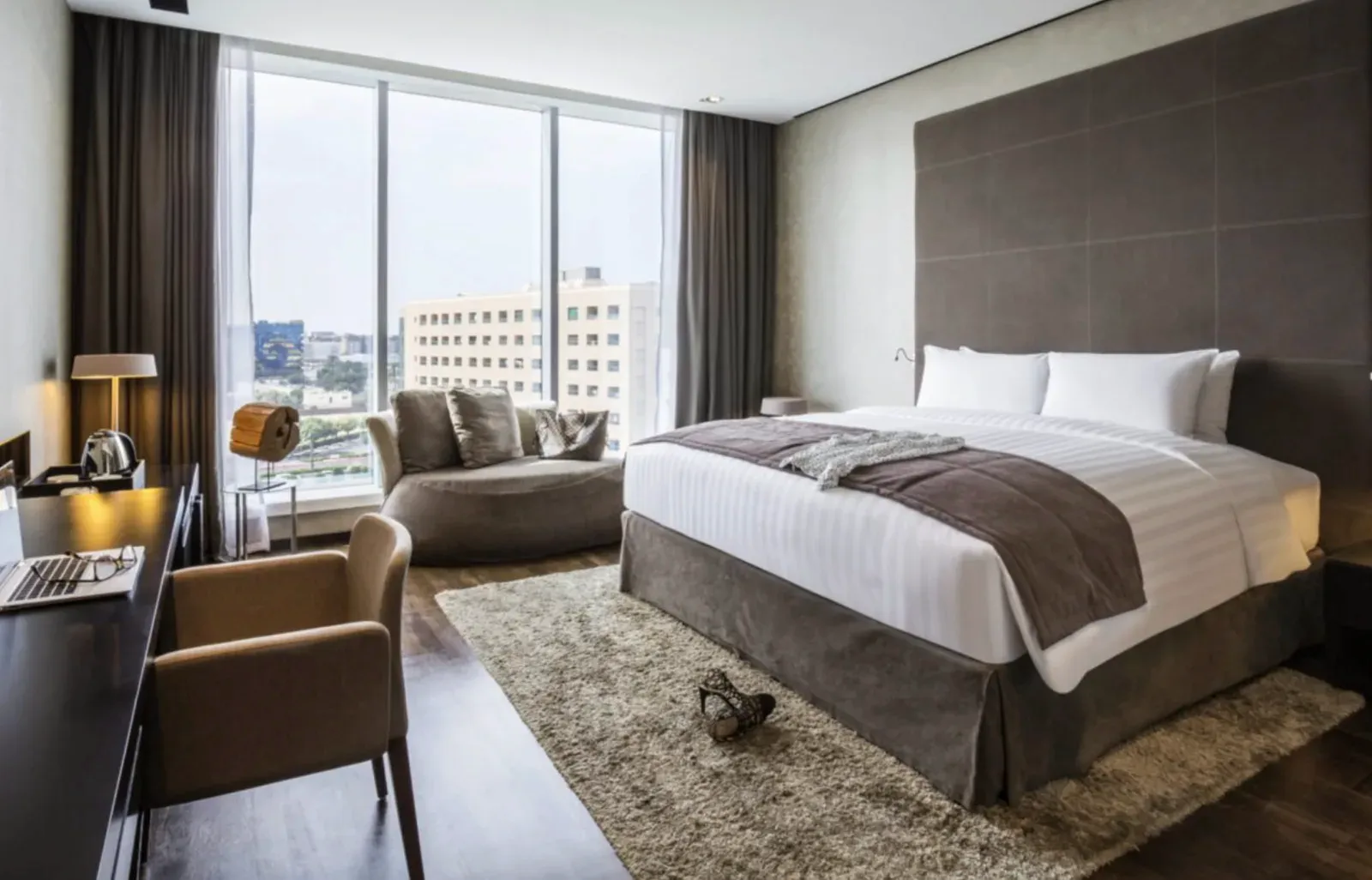
A downtown Stamford hotel like a Marriott, Hilton, or Sheraton property does not shut its doors for a renovation. Guests are checking in on the same floor a demising wall is being reframed, and the general manager’s real requirement is not just quality work, it is quiet, contained, odor-free work that does not show up in a guest review. Stamford Elite Drywall runs hotel renovation work in phased blocks, closing off one wing or one stack of rooms at a time behind sealed containment, and scheduling the noisiest framing and demolition steps for daytime housekeeping windows rather than overnight hours when guests are trying to sleep two rooms away. Dust and odor containment matters here for a different reason than on a hospital job: it is not an infection-control requirement, it is a guest-experience requirement, and a hotel PIP that generates complaints mid-renovation can cost the property more in comped rooms than the construction itself.
Guest-room demising and corridor walls carry a real acoustic and fire-rated job to do under Residential/Hotel (R-1) occupancy. Two guests in adjoining rooms expect not to hear each other’s television or conversation, which means the party wall between rooms needs the mass and detailing an acoustic assembly requires, not a standard single-layer partition. QuietRock or a comparable sound-rated panel is worth specifying at guest-room demising walls precisely because a brand-standard renovation gets measured against guest satisfaction scores, and a noise complaint traces straight back to a partition that was framed to a budget spec instead of the acoustic one. Corridor walls carry their own fire-rating requirement under the 2022 Connecticut State Building Code (2021 IBC/IRC), since a hotel corridor is an egress path serving sleeping occupants, and that rating has to be documented and inspected correctly before the wing reopens to guests.
Finish level and schedule pressure on the parts guests actually see
Guest rooms, corridors, and public spaces like a lobby or ballroom near Stamford Town Center get judged on finish quality in a way a warehouse or back-of-house area never is. A guest-room wall finished to anything less than a smooth Level 4 or Level 5 finish shows every seam under the room’s accent lighting, and a ballroom or pre-function space used for events demands an even higher standard because it is photographed for weddings and corporate functions. Stamford Elite Drywall finishes these visible surfaces to the level the space’s use actually requires, and holds the phased schedule brand-managed renovation teams depend on, because a hotel PIP typically runs against a hard brand-compliance deadline, and a missed finish date on one wing delays revenue on every room behind it in the sequence.
Materials & standards
Products & materials we use
- QuietRock or comparable sound-rated panel at guest-room demising walls
- Type X board at corridor and rated egress assemblies
- USG Sheetrock at guest-room and public-space walls
- DensGlass sheathing where moisture exposure applies (pool, spa, bathroom-adjacent walls)
Standards & codes we work to
- 2022 Connecticut State Building Code (2021 IBC/IRC)
- Residential/Hotel (R-1) occupancy egress and corridor fire-rating requirements
- GA-214 finish levels for guest-room and public-space finish quality
- NFPA fire ratings for sleeping-occupancy corridors
What the terms mean
- Guest-room demising wall
- Phased occupied-building work
- Acoustic/STC partition
- Property improvement plan (PIP) renovation
The work this involves
The techniques that go into a project like this:
Frequently asked questions
Can renovation work happen while the hotel stays open to guests? +
Yes. Stamford Elite Drywall phases the work wing by wing or floor by floor behind sealed containment, scheduling the loudest steps for daytime hours so occupied rooms nearby are not disrupted.
What makes a guest-room wall quieter between rooms? +
A sound-rated panel like QuietRock, insulation in the cavity, and sealed penetrations at outlets and plumbing chases all contribute. A standard single-layer partition will not meet typical brand acoustic expectations between guest rooms.
Do hotel corridor walls need a fire rating? +
Yes. Corridors serving guest rooms are egress paths for sleeping occupants under Residential/Hotel (R-1) occupancy, and the 2022 Connecticut State Building Code sets a fire-rating requirement for those assemblies that has to be documented for inspection.
Can a PIP renovation schedule be held to a brand compliance deadline? +
Yes, that is typically the constraint driving the whole project. Stamford Elite Drywall sequences framing, board, and finish work to hold the phased schedule a brand-managed renovation depends on.
What finish level does a hotel lobby or ballroom need compared to a guest room? +
Public and event space near heavy foot traffic and photography, like a ballroom or pre-function area, typically warrants the highest finish level, while guest rooms are finished smooth enough that seams do not show under accent lighting.