
Signs you need this
- • Hearing a neighbor's television, footsteps, or conversation clearly through a shared wall in a Harbor Point condo or multi-family unit
- • Train noise and vibration from the Stamford Transportation Center corridor or nearby rail lines carrying into a downtown-adjacent home or unit
- • A home theater or media room where dialogue and bass leak into adjoining rooms, disrupting the rest of the house
- • A home office or music room that needs sound contained in both directions, keeping outside noise out and inside noise from disturbing the household
Why Harbor Point and downtown Stamford living creates a different noise problem than a single-family home
Harbor Point’s multi-family towers and Stamford’s growing stock of condo conversions near downtown put more people closer together than the city’s older single-family neighborhoods ever did, and party-wall noise transfer is the tradeoff nobody mentions during the sales tour. A standard single layer of drywall on wood or metal studs does very little to stop airborne sound, voices, a television, a dog barking, from crossing into the next unit, because sound travels efficiently through a rigid, continuous structure. Add proximity to the Stamford Transportation Center corridor and active rail lines running through downtown, and some units deal with a second noise source entirely: low-frequency train vibration that travels through a building’s structure rather than through the air, which standard mass-based soundproofing barely touches.
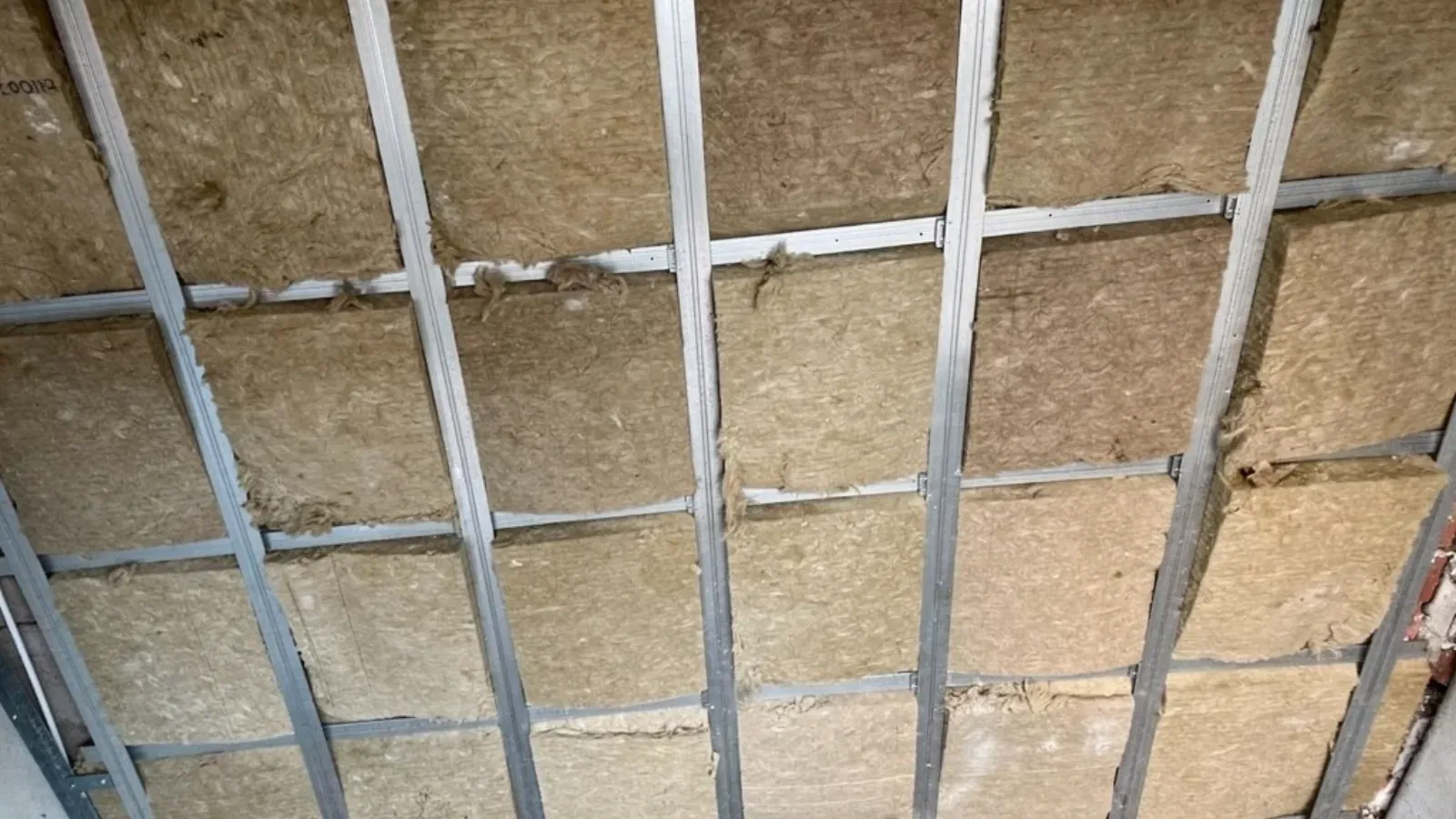
Stamford Elite Drywall treats these as two different engineering problems rather than one soundproofing job. Airborne noise responds well to resilient channel, which mechanically decouples the drywall layer from the stud so vibration can’t travel directly through a rigid connection, combined with sound-rated board like QuietRock that adds internal damping layers without adding much wall thickness, a real consideration in units where every inch of floor space matters. Low-frequency vibration from trains or nearby traffic needs mass and decoupling working together, since a lightweight assembly simply resonates along with the vibration instead of absorbing it.
The home theater build-out is a different acoustic problem than a party wall
North Stamford and mid-country homeowners building dedicated home theaters or media rooms are usually solving for the opposite direction of the same physics: keeping bass and dialogue contained inside the room rather than blocking noise from the outside. That calls for a fully decoupled assembly on every wall and often the ceiling, since sound bleeding out through a shared ceiling into a bedroom above is one of the most common complaints in a home theater build that skipped ceiling treatment to save cost. Double-layer drywall, staggered stud framing where the room is new construction, and acoustic sealant at every outlet box and perimeter gap all matter here, because a single unsealed gap around an electrical box can undo a meaningful percentage of an otherwise well-built wall’s isolation performance.
The honest answer Stamford Elite Drywall gives every client is that no drywall assembly, however well built, makes a room silent. What a properly designed acoustic assembly does is bring sound transmission down to a level where normal household life, or a shared wall with a neighbor, stops being a daily irritation. Setting that expectation up front, then building the assembly that actually matches the noise source, whether that’s a train vibrating through a downtown building’s structure or a subwoofer three rooms away, is what separates a soundproofing job that works from one that just adds cost without addressing the actual noise path.
Materials & standards
Products & materials we use
- QuietRock
- USG Sheetrock
- National Gypsum Gold Bond
- CertainTeed
Standards & codes we work to
- ASTM C1396/C840
- 2022 Connecticut State Building Code (2021 IBC/IRC)
What the terms mean
- resilient channel
- acoustic wall
- sound-rated board
- decoupled assembly
- joint compound
- acoustic sealant
Options & variants
| Option | When it applies | Cost |
|---|---|---|
| Resilient channel with standard board | Moderate airborne noise reduction between rooms | Lower cost |
| QuietRock or sound-rated board assembly | Higher-performance acoustic wall without adding significant wall thickness | Moderate cost |
| Double-layer drywall with acoustic sealant | Party walls between condo units or against a shared multi-family wall | Moderate to higher cost |
| Full decoupled assembly for home theaters | Dedicated media rooms needing maximum isolation in both directions | Higher cost, most labor-intensive |
What affects cost
- • Whether the wall is new construction, where acoustic assemblies are simpler to build in, versus retrofitting into an existing finished room
- • The type of noise being addressed: airborne voice and television noise costs less to mitigate than low-frequency train vibration or bass
- • Whether one wall needs treatment or the project involves ceiling and multiple walls, as in a full home theater build-out
- • Sealing every electrical box, outlet, and penetration matters as much as the board itself, since sound leaks through the smallest gaps
What to expect
- 1
Noise assessment
On-site, we identify whether the problem is airborne, impact, or low-frequency, and which walls or ceilings are the transmission path.
- 2
Assembly recommendation
We recommend the assembly type based on the noise source and the existing wall or framing condition.
- 3
Installation
Resilient channel or the sound-rated board system goes in, with careful attention to decoupling the new layer from the framing where the assembly calls for it.
- 4
Acoustic sealing
Every penetration, outlet box, and perimeter gap gets acoustic sealant, since sound bypasses even a well-built assembly through unsealed edges.
- 5
Final finish and walkthrough
We finish the assembly and walk through realistic expectations for the noise reduction achieved.
When this isn’t the right call
- If the noise problem is coming through a floor or ceiling assembly rather than a wall, that typically needs a different acoustic approach involving flooring underlayment, outside a drywall-only scope.
- If the project is a general basement remodel without a specific acoustic goal, basement drywall finishing is the better fit.
- If the wall in question also needs fire-rated separation, such as a garage or a demising wall in a commercial space, fire-rated drywall assembly or garage fire separation is the better fit, and the two can often be combined with acoustic performance.
Frequently asked questions
Will soundproofing drywall eliminate noise completely? +
No wall assembly eliminates sound entirely. A well-built acoustic assembly with resilient channel or sound-rated board substantially reduces airborne noise like voices and television, and can meaningfully reduce impact and low-frequency noise, but Stamford Elite Drywall sets realistic expectations before starting rather than overpromising a silent wall.
What's the difference between QuietRock and resilient channel? +
Resilient channel is a metal furring strip that decouples standard drywall from the framing, reducing vibration transfer through the studs. QuietRock is a sound-rated board with built-in damping layers that can achieve similar or better performance in less wall thickness, which matters in a room where space is tight.
Can you soundproof an existing finished room, or does it need to be gutted? +
Retrofitting is possible but generally less effective than building the assembly in during a renovation, since adding resilient channel or a second board layer to an existing wall adds thickness and requires removing trim, outlets, and sometimes flooring transitions.
Will this help with train noise from the Stamford Transportation Center area? +
Low-frequency vibration from trains is harder to stop than airborne voice noise, but a decoupled assembly with mass-loaded components meaningfully reduces how much of that vibration transfers into a room, especially combined with sealed windows.
How is soundproofing different for a party wall between condo units versus a home theater? +
A party wall assembly focuses on stopping sound in both directions between two occupied spaces, often within the constraints of an existing building's wall cavity. A home theater build often has more room to add a fully decoupled double-layer assembly since it's new construction within a house.